

We Need To Read 'Maybe You Should Talk to Someone' by Lori Gottlieb
This memoir is so well written that it sounds like a novel

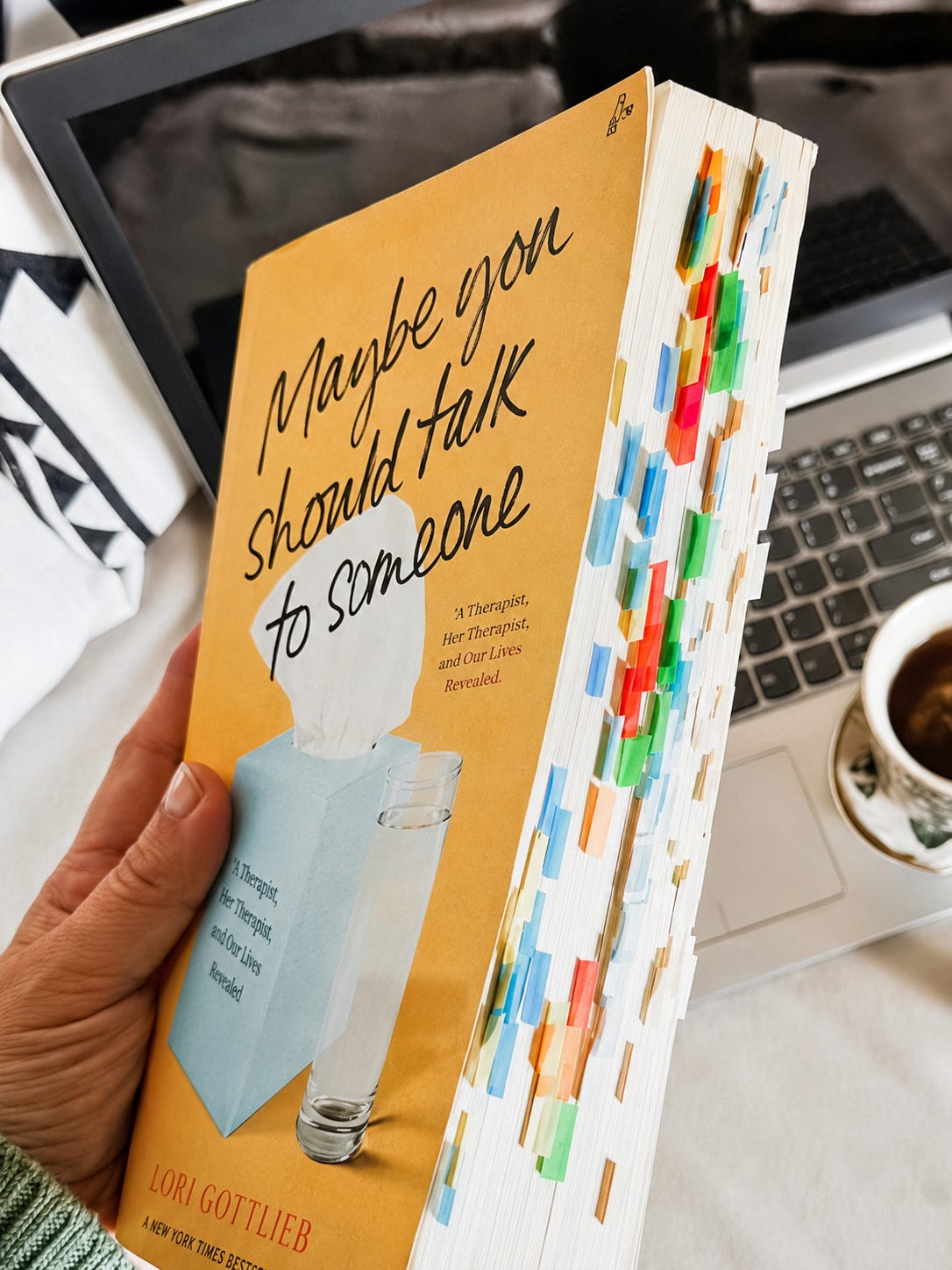
Our July reading, Maybe You Should Talk to Someone, is a book about therapy, grief, relationships, change, and the stories people tell themselves in order to survive.
It reads almost like fiction, but it is a memoir: Lori Gottlieb writes about her own life, her work as a therapist in Los Angeles, and the sessions with her patients that reveal how human, messy, and connected we all are.

Below are some of the quotes that will stay with us:
“There’s no hierarchy of pain. Suffering shouldn’t be ranked, because pain is not a contest.”
When someone shares a problem, comparing their suffering to someone else’s rarely helps.
“I lost my job.” - says your friend.
“At least you’re married. When I lost my job last year, I had no one to share the rent with.” - you might answer.
Sometimes this is disguised as optimism:
“Look at the cup half full.”
“It could be worse.”
But pain does not need to be minimized to be survived.
Sometimes the best thing to offer is silence.
Sometimes the most helpful response is a question.
Instead of:
“Let me know if you ever need anything.”
Try:
“Would it be helpful if I brought dinner tomorrow?”
“Would it help if I came with you?”
“Would it be useful if I took care of this one thing?”
Support becomes easier to accept when it is specific.

“But she doesn’t tell me she’s angry.
She just acts angry, and I’m supposed to ask her what’s wrong.”
Communication in general is hard.
Communication in relationships is harder.
Wanting to be noticed is human.
Wanting someone to understand that something is wrong is human.
But expecting another person to know exactly what is needed, without saying it, can turn hurt into distance.
We spend so much time masking our feelings that, when something finally slips, the person in front of you may know something is wrong, but not what caused it.
Was it something said today?
Something forgotten yesterday?
Something that happened months ago?
What helps: shortening the time between frustration and conversation.
Sleeping on it can be useful when it creates space to think about how to approach the situation.
Sleeping on it for weeks, while silently rehearsing the hurt, usually makes the conversation harder.
A kinder place to start:
“I see that you’re upset. Is it because of what happened earlier?”
“I might be wrong, but I want to understand.”
“Can we talk about what felt hurtful?”
“We can’t have change without loss, which is why so often people say they want change but nonetheless stay exactly the same.”
This is a reminder worth returning to.
Many people living abroad know this feeling well: choosing to leave a lot behind in order to pursue the life they wanted to build.
But this also happens on a smaller scale, every day.
Wanting to be fit may mean giving up midnight Netflix binges, so the next morning has enough energy for exercise.
Wanting to learn a new skill may mean stepping out of the comfort zone (or missing a few hangouts) to stay home and study.
Wanting a different life requires making space for it.
Because when nothing is allowed to go, everything gets squeezed in.
And often, the first things sacrificed are the ones that are essential: meals, sleep, rest, movement.
Change asks for more than desire.
It asks for trade-offs.
So when the path starts to feel hard because something familiar is being missed, it may help to remember where the path is leading.
The shopping cart left unchecked.
The food choice that supported a goal.
The evening spent studying instead of going out.
They may feel like losses in the moment.
But from the perspective of a healthier, wealthier, more fluent future self, they become part of the shift that made that future possible.
-
One more thought from the book:
People are rarely only what they show on the surface.
Behind anger, there may be fear.
Behind control, there may be grief.
Behind silence, there may be shame.
Behind humor, there may be pain.
Therapy, in the book, is not presented as a magical fix.
It is presented as a place where people slowly become honest enough to see themselves more clearly.
And sometimes, being seen clearly is where change begins.
I hope you know how welcomed you are at our book club meetings.
You can see all dates and RSVP at gatherpause.com